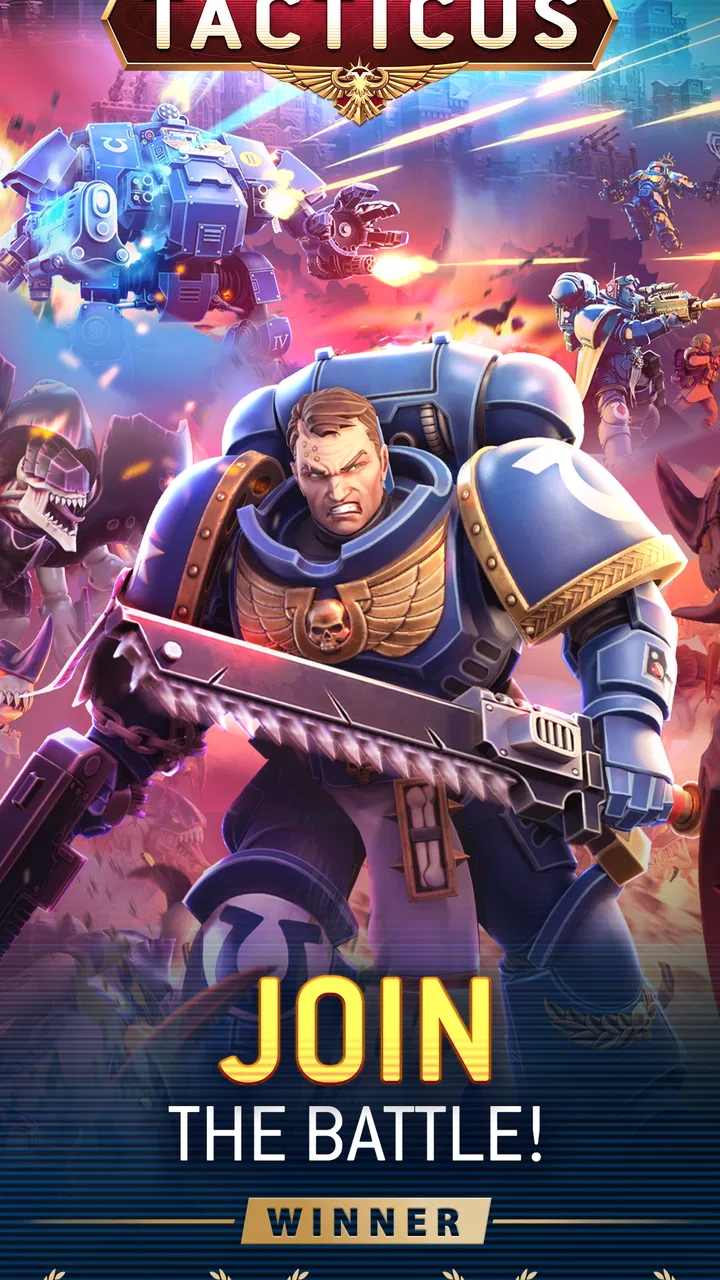
Warhammer 40,000: Tacticus ™
- 4.5
- Rating
- 5.00M
- Installs
- Free
- Price
 Analysis by App-foxy
Warhammer 40,000: Tacticus ™ is the kind of strategy game that makes a short break feel purposeful. I can open it, make a few careful decisions, finish a small objective, collect something useful, and stop without feeling that I abandoned a long real-time match. When I return, there is usually a clear reason to play again. That rhythm is the main attraction, but it also explains the game’s limits: progress is built around repeated battles, resource planning, and patience rather than one uninterrupted campaign.
As a free turn-based tactical RPG from Snowprint Studios AB, it places squads from the Warhammer 40,000 setting on compact battlefields where positioning matters as much as raw strength. The game is rated Teen, and it suits players who enjoy building a roster over time, learning what each unit does, and making several meaningful choices during a fight. It is less suitable if you want a completely self-contained premium game or dislike mobile games that ask you to revisit the same systems regularly.
How the battle loop feels from the first move to the next session
I find the first few battles easy to enter, but the real adjustment is learning to treat every move as a choice about the next turn, not just the current attack. In this section, I’ll look at how that compact battle loop creates momentum—and why the same rhythm can feel repetitive if you come looking for constant surprises.
You May Also Like

 Blood Strike: 2.5 Anniversary
Blood Strike’s Loadouts Turn Every Drop Into a Tactical Gamble
A close look at Blood Strike’s custom loadouts: how fast access to signature weapons reshapes its battle royale rhythm, rewards preparation, and narrows the gap between fights.

 Pandora - Music & Podcasts
Pandora’s Music Is Easy to Start, but Harder to Recover
Pandora’s strength is its low-effort path from a seed to a station. Its weak spot is how much confidence it asks you to place in connection, setup, and quiet recovery.

 8 Ball Pool
 Is Built on Rivalries, Rematches, and Routine
A close look at the rivalries, rematches, shared routines, and unanswered safety questions that turn a quick pool match into a persistent mobile community.

 Samsung Music
’s Quiet Strength Is Playing What You Already Own
Its reach comes less from spectacle than from dependable access to a personal library. That simplicity is both the app’s strongest retention engine and its ceiling.

 AccuWeather: Weather Radar
AccuWeather Review: A Quick, Clear Forecast for Everyday Decisions
For everyday plans, the best forecast is the one you can understand quickly. AccuWeather makes rain timing, radar, and local conditions easy to act on, with a few trade-offs.

 Hill Climb Racing
Why Hill Climb Racing Still Turns Crashes Into One More Run
A tiny car, a bumpy hill and one more upgrade: Hill Climb Racing keeps resurfacing because its simple chaos makes every near-miss feel personal.
More From Our News Desk



The first action is simple, but the consequences are not
The first thing I notice in a match is how quickly the game puts a decision in front of me. A unit can move, attack, or use an ability, but the best choice depends on the shape of the battlefield and what I expect the opponent to do next. Moving toward an enemy may create immediate damage, yet it can also leave that character exposed. Holding position may look passive, but it can preserve a better angle for the following turn.
That makes the opening action more interesting than simply tapping the strongest attack. I have to look at cover, distance, targets, and the order in which I want to activate my team. A powerful ability used too early may remove one threat while leaving another enemy free to punish the exposed unit. The game rewards me for thinking one turn ahead, even when the mission itself is brief.
The compact maps help keep this decision-making readable on a phone. I am not managing a huge army across a sprawling battlefield. Instead, I am directing a small group through a focused tactical problem. That scale makes it easier to understand why a turn went well or badly, which is important in a game where improvement comes from recognizing mistakes rather than merely repeating taps.
My most useful habit is to pause before committing the first attack. I check which enemy can reach my frontline, which ally benefits from protection, and whether an ability is better saved for a tougher target. This small delay prevents many avoidable losses. It also turns each battle into a puzzle with a visible answer, even when the answer is not immediately obvious.
Every attack gives information, not just damage
The feedback rhythm is built from clear changes on the battlefield. An attack removes health, an ability changes the immediate threat, and a successful position can make the next turn safer. I like that the result of a choice is usually easy to read. If I place a unit behind protection or eliminate a dangerous opponent first, the board visibly becomes more manageable.
This feedback is especially satisfying when a weaker squad survives because I used its abilities in the right order. A victory does not always feel like a demonstration of overwhelming power. Sometimes it feels earned through target selection, timing, and keeping a vulnerable character away from danger. Those moments are what give the tactical layer more staying power than a simple collection game.
There is also a useful difference between winning and winning efficiently. A mission may be completed, but losing a character or taking unnecessary damage can make the result less satisfying. That encourages me to replay certain encounters with a cleaner plan. The replay is not only about chasing a higher score; it is a chance to test whether a different opening, formation, or ability sequence produces a more reliable outcome.
One trade-off becomes apparent after several sessions: the same clarity that makes battles approachable can make some encounters feel familiar. Once I understand the enemy pattern and map layout, the challenge may shift from discovering a solution to executing it consistently. Players who enjoy refining a known plan will appreciate this. Players who need constant mechanical novelty may find the repetition less rewarding.
Squad building turns victories into long-term decisions
The reward arrives in more than one form. A completed battle gives me the immediate satisfaction of solving the encounter, while the longer-term progression helps develop the roster. That second layer changes how I view a loss. It is frustrating, but it can still point me toward a better upgrade, a different team composition, or a need to improve a particular unit.
Building a team is not simply a matter of choosing the characters with the highest apparent power. I pay attention to how units support one another and whether their abilities cover different battlefield problems. A durable character may create room for a fragile damage dealer. A specialist may be less impressive alone but valuable when the mission demands a particular kind of response. The most useful roster is the one that gives me options, not just a single favorite lineup.
This is one of the game’s more important hidden lessons: resources are easier to waste than battles are to lose. I try not to improve every available character at the same pace. Concentrating materials on a practical core team gives me a stronger foundation, while spreading everything thin can leave several units underpowered. Later, I can invest in alternatives when a mission or mode makes them worthwhile.
The collection element also provides a reason to inspect rewards instead of tapping through them automatically. A new component may not transform my team immediately, but it can complete a needed improvement or move a character toward a more useful role. I recommend deciding what kind of squad I want before spending everything. That simple plan makes the reward screen feel like part of the strategy rather than a separate chore.
Players should also understand the free-to-play structure before committing time. The game costs nothing to start, but it includes in-app purchases ranging from $1.99 to $99.99 per item. I can enjoy the tactical battles without treating every purchase as necessary, yet the presence of optional spending can affect how quickly a roster develops. My advice is to view purchases as acceleration, not as a substitute for learning the game. If spending creates pressure, the progression model may become more stressful than enjoyable.
Why another session begins after the reward screen
The reset is what makes the game feel suited to mobile play. After a battle, I return to the broader progression layer, review what changed, and choose the next manageable goal. That goal might be improving a key unit, attempting another mission, or working toward a reward that supports the team I am building. The session ends naturally because the game gives me a stopping point.
In an everyday scenario, I might play while waiting for an appointment. I can complete a battle, collect the result, and close the app without needing to remain available for a live opponent. Later, I can return with a fresh objective instead of trying to remember a complicated real-time situation. This makes the game more comfortable for short, interrupted sessions than many competitive strategy alternatives.
At the same time, the reset is not always refreshing. If progress slows or a mission requires repeated attempts, the next session can feel like returning to a checklist. The game’s strongest loop depends on the reward being meaningful enough to justify the next battle. When the improvement is small, the action-feedback-reward cycle loses some of its energy.
I find it helps to set a personal stopping rule. Rather than playing until every available task is complete, I stop after a useful upgrade, a successful attempt, or a small number of focused battles. This keeps the routine from becoming automatic. It also makes the next session more appealing because I return with a clear intention instead of fatigue.
What makes the tactical choices worthwhile
The game stands out from many casual mobile strategy titles because the battle itself remains the center of attention. The roster and rewards matter, but they do not completely replace decision-making. I still need to judge whether to advance, protect, attack, or wait. That is the core reason I return: the next match offers another chance to make the same kinds of choices more intelligently.
Compared with a real-time strategy game, this turn-based format is calmer and easier to interrupt. I do not need fast reflexes or a continuous block of concentration. Compared with a straightforward character-collection game, it gives the collected units a more practical purpose because I use them in tactical situations rather than only watching their power increase. Compared with a traditional premium strategy game, however, it is more dependent on ongoing progression and repeated sessions.
That comparison also clarifies who should skip it. If I want a single purchase with a fixed beginning and ending, this is not the best fit. If I dislike managing several upgrade paths or prefer action games where timing matters more than planning, the deliberate pace may feel slow. And if I am likely to spend impulsively whenever progress feels gradual, the free-to-play structure deserves serious caution.
On the other hand, I would recommend it to someone who likes Warhammer 40,000 but wants a manageable way to interact with the setting on a phone. I would also suggest it to players who enjoy turn-based battles but do not want every session to last an hour. The Teen rating is worth keeping in mind for families, especially because the game includes in-app purchases and a darker science-fiction setting.
Practical habits that improve the experience
My first practical tip is to treat movement as an ability in its own right. A unit that deals less damage can still be valuable if it blocks a route, protects an ally, or forces an enemy to spend a turn repositioning. I get better results when I ask what the enemy will be allowed to do after my move, not just how much damage my move causes immediately.
Second, I avoid using every special ability as soon as it becomes available. Saving one strong effect for the moment when several threats converge can change the entire battle. This is particularly useful when a mission appears easy at the start but becomes dangerous after the first enemy is defeated. The best turn is often the one that prevents the next problem rather than the one that produces the biggest number now.
Third, I use failed attempts as controlled experiments. I change one element at a time: the first target, the opening position, or the order of activations. If I change everything, I do not know what fixed the problem. This approach turns repetition into learning and reduces the feeling that I am simply grinding against an arbitrary wall.
Finally, I keep the roster focused. It is tempting to improve every new character because each one represents a fresh possibility. In practice, a dependable main squad gives me more immediate value. I branch out when I have a clear reason, such as a mission that exposes a weakness or a role my current team cannot cover well.
Performance, access, and long-term commitment
The game is available for Android devices running at least version 7.0, which makes it accessible to a broad range of compatible phones and tablets. My experience with this kind of title is best when the device has enough free space and the connection is stable, particularly when moving between battles and progression screens. I would still check the device’s available storage and account setup before committing to a long-term roster.
Its audience size suggests that it has found a substantial mobile community: the game has passed one million installs, with an average rating of 4.5 from around 122 thousand ratings and about 13 thousand written reviews. Those figures do not replace personal taste, but they do indicate that the combination of Warhammer presentation, turn-based combat, and collection-driven progression has broad appeal.
The current version is 1.36.64, and the game released on August 15, 2022. Those details matter mainly because this is not a short experimental release that I would expect to finish in one evening. It is designed as an ongoing game, so the right question is whether I enjoy its routine: plan a turn, see the result, collect progress, improve the squad, and begin again.
My verdict on the complete loop
After spending time with it, I see Warhammer 40,000: Tacticus ™ as a strong choice for players who want tactical decisions in compact sessions. Its best moments come when a careful move rescues a difficult battle, when a saved ability turns a dangerous turn around, or when a modest reward completes an upgrade that changes how I approach the next mission.
Its weaker side is the repetition built into that same structure. The game asks me to accept gradual progress, revisit familiar patterns, and manage my expectations around optional spending. That is not a flaw for everyone, but it is a real trade-off. The experience works best when I enjoy the process of improving a squad rather than rushing toward a final destination.
My recommendation is straightforward: try it if you want a patient, turn-based Warhammer strategy game that gives each short session a clear purpose. Keep the roster focused, think before spending resources, and judge success by better decisions as well as rewards. If that action-feedback-reset rhythm sounds satisfying, Snowprint Studios AB has built a game with enough tactical texture to keep pulling me into one more battle.
FAQs for Warhammer 40,000: Tacticus ™
01What is Warhammer 40,000: Tacticus and how does it differ from other strategy games?
Warhammer 40,000: Tacticus is a turn-based strategy game set in the iconic Warhammer 40,000 universe. Unlike other strategy games, Tacticus emphasizes tactical depth and unit positioning. Players control squads of iconic Warhammer units, each with unique abilities, to outmaneuver opponents on a grid-based battlefield. The rich lore and detailed graphics offer an immersive experience for both fans and newcomers.
02Is Warhammer 40,000: Tacticus free to play, and are there in-game purchases?
Warhammer 40,000: Tacticus is free to download and play, making it accessible to a wide audience. However, it does offer in-game purchases, which can enhance gameplay through additional characters, upgrades, and resources. While these purchases can provide an advantage, they are not necessary to enjoy or progress through the game, as skill and strategy are key.
03What platforms is Warhammer 40,000: Tacticus available on, and what are the system requirements?
Warhammer 40,000: Tacticus is available for both Android and iOS devices. For Android, the game requires Android version 6.0 or higher, and for iOS, it requires iOS 11.0 or later. The game is optimized for smooth performance on a variety of devices, though a stable internet connection is recommended for optimal gameplay.
04How does multiplayer work in Warhammer 40,000: Tacticus, and can I play with friends?
Warhammer 40,000: Tacticus features a robust multiplayer mode where players can compete against each other globally. You can challenge friends or random opponents in tactical battles. The game offers leaderboards, allowing players to see how they rank against others. Multiplayer matches are designed to test strategic skills and provide a competitive edge.
05What kind of updates and support can players expect for Warhammer 40,000: Tacticus?
Players can expect regular updates for Warhammer 40,000: Tacticus, which include new content, balance adjustments, and bug fixes. The developers are active in the community, often taking feedback to improve the game. Support is available through in-game help features and online forums where players can discuss strategies and report issues.
Pros
- Engaging turn-based strategy gameplay.
- High-quality graphics and animations.
- Diverse roster of Warhammer characters.
- Regular updates with new content.
- Easy to learn for beginners.
Cons
- In-app purchases can be pricey.
- Requires constant internet connection.
- Some missions feel repetitive.
- Occasional bugs disrupt gameplay.
- Limited customization options.

Warhammer 40,000: Tacticus ™
Gallery